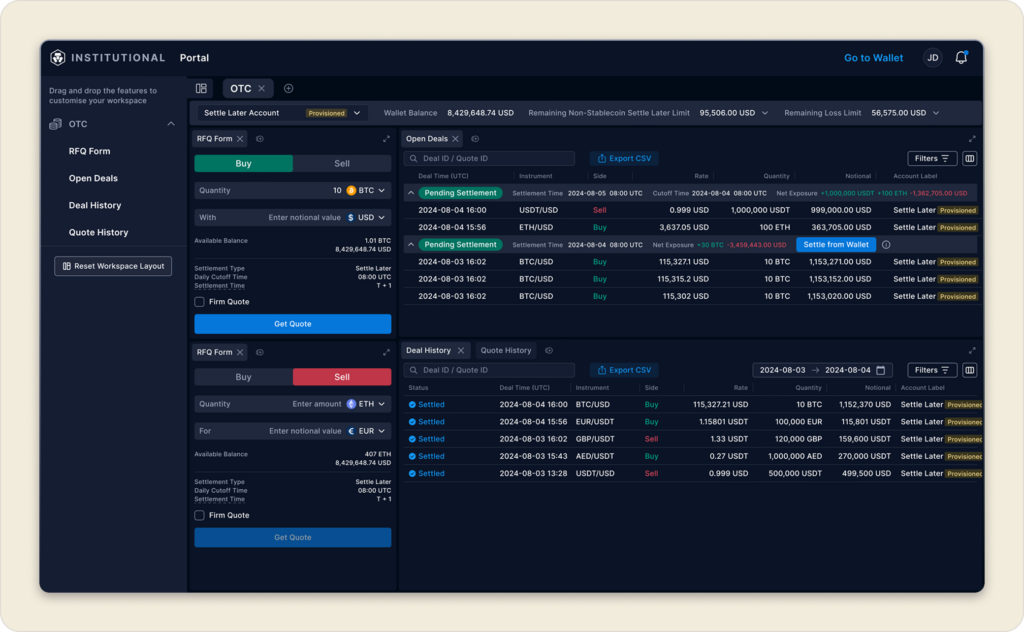
Designed Crypto.com’s first self-service OTC trading platform from 0→1, enabling institutional clients to execute high-value trades independently.

Context
OTC trading was managed primarily through the sales team, creating a manual process for institutional clients executing large trades.
Clients relied on sales representatives for pricing, execution, and settlement, limiting efficiency and scalability.
Goal – create a self-service OTC platform that gave institutional clients greater control while supporting the complex workflows required for professional trading.
Understanding the problem
With no existing product to build from, I worked closely with OTC managers and the sales team to understand how institutional trading operated.
Discovery included
- Interviews with OTC managers and sales teams.
- Mapping institutional client journeys and operational workflows.
- Identifying pain points and opportunities for self-service.
Key learning – institutional clients needed more than a trading interface – they required a platform that supported different user roles, team collaboration, and flexible trading workflows.
Design & solution
I led the product design from 0→1, defining the product vision, user journeys, and interaction patterns for the new platform.
Working closely with Product and Engineering
- Simplified complex OTC workflows into an intuitive self-service experience.
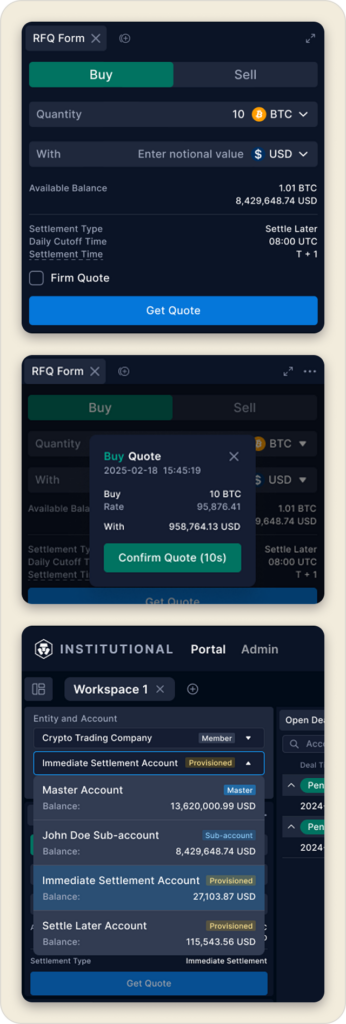
- Designed a modular workspace that could adapt to different trading styles.
- Introduced role-based access to support different responsibilities within institutional organisations.
- Balanced user needs with technical constraints to create a scalable foundation for future institutional products.
Impact
- The self-service platform processed 2x more trading volume than the sales-assisted channel.
- 80% increase in self-service adoption, demonstrating strong demand for independent institutional trading.
- Strengthened the institutional sales proposition and supported onboarding of new clients with a scalable self-service trading experience.
- Internal sales teams requested similar design patterns for their own operational tools.
- Established the foundation for role-based access, enabling institutional organisations to collaborate securely and supporting more complex organisational structures as the platform expanded.