Used funnel analysis, user research, and A/B testing to identify onboarding friction and improve the journey from sign-up to first trade.
Understanding where users struggled
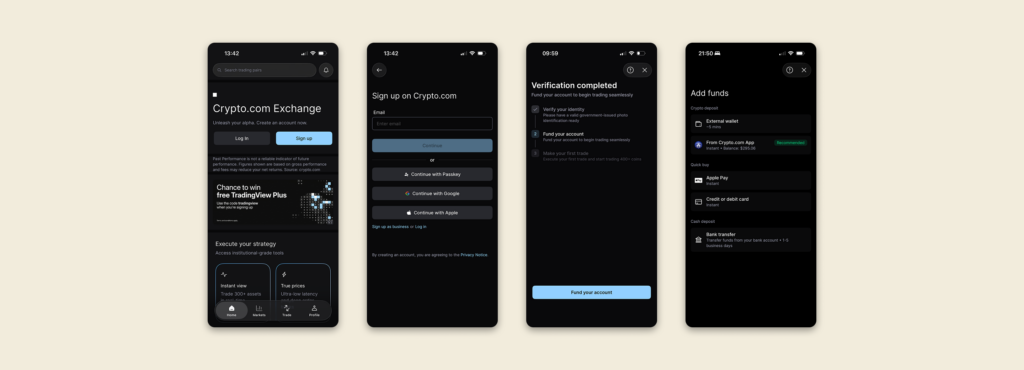
I started by analysing the live onboarding funnel to understand where users were dropping off. 90-day funnel analysis revealed key friction points across:
Sign-up → Phone verification → KYC → Funding → First trade
To understand why users struggled, I combined behavioural data with qualitative research:
- User interviews across the US and UK.
- Customer feedback analysis.
- Collaboration with Product and business teams.
Selecting biggest opportunities around:
- Early onboarding abandonment.
- KYC completion.
- Transition from approved account to first deposit.
- User confidence during funding.
Turning insights into measurable hypotheses
Based on the funnel analysis and user research, I have created several A/B-tested experiments targeting specific drop-off points.
1. Phone-first onboarding
Problem – early abandonment after sign-up.
Hypothesis – starting with phone verification would reduce friction and help identify higher-intent users.
Test – moved phone number capture to the first onboarding step while keeping email and social sign-in available as secondary options.
2. Reducing authentication friction
Problem – users needed a faster and easier way to return to the platform.
Hypothesis – introducing passkeys and biometrics would improve future login experience without removing familiar authentication options.
Test – prompted users to set up passkeys/biometrics immediately after password creation.
3. Improving KYC confidence
Problem – users abandoned when they were unsure about the verification process.
Hypothesis – clear expectations upfront would reduce uncertainty and improve completion.
Test – introduced clearer guidance around ID checks, selfie verification, and estimated completion time.
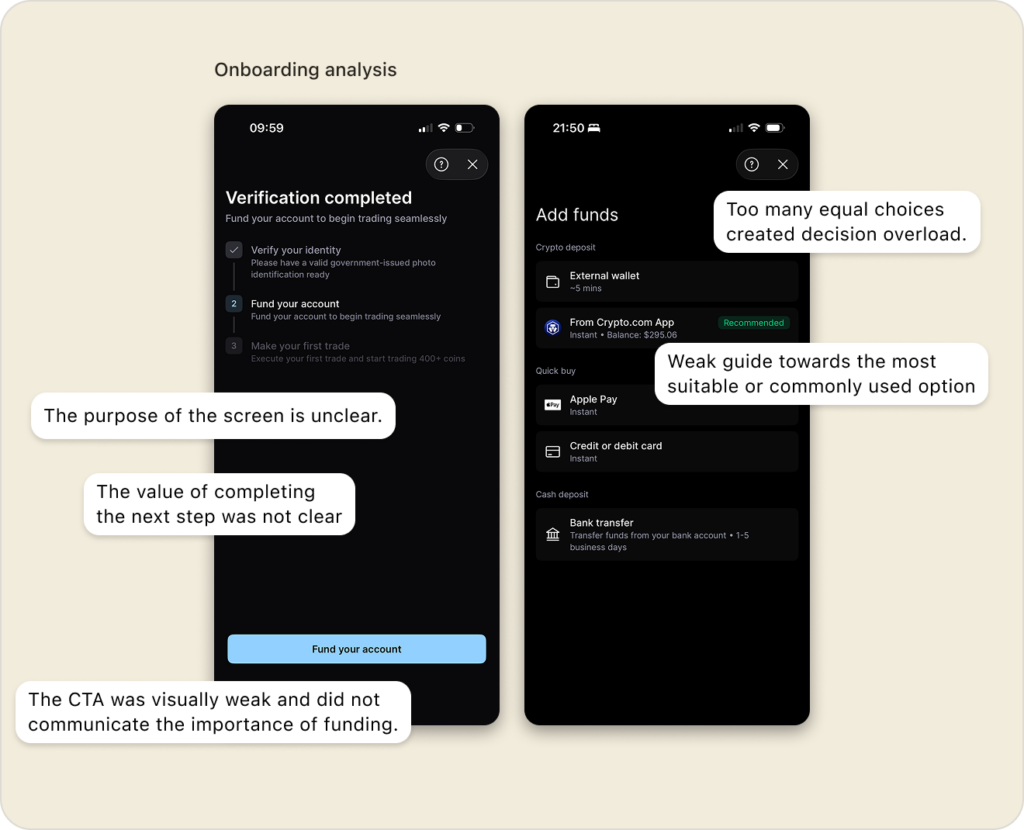
4. Improving first deposit conversion
Problem – users hesitated when choosing funding methods and were uncertain about deposit processing times.
Hypothesis – interviews showed that some users delayed their first deposit because they were unsure how long fiat deposits would take. Funnel analysis also showed that some funding methods were used significantly more frequently than others.Improvements
- Prioritised the most popular deposit method as the recommended option based on user behaviour data, while keeping other methods available but less prominent.
- Updated processing time messaging, that helped set clearer expectations while reducing unnecessary concern:
- from: “1–5 business days”
- to: “Usually within hours, occasionally up to 5 business days”
Impact
- Created a continuous optimisation approach combining behavioural data, user research, and experimentation.
- Enabled the team to make evidence-based product decisions instead of relying on assumptions.
- Built a foundation for ongoing improvements to onboarding conversion and user activation.